Jamie Brost
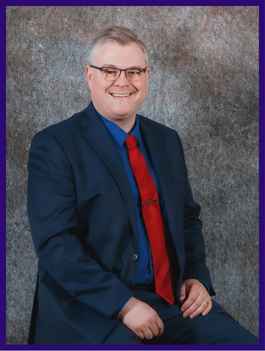
I have often toyed with the question: “If you travelled back in time, what would you tell your past self?” It is a difficult exercise for me to imagine, especially considering my family and my recent entry into Christ's Church: Holy Orthodoxy.
Until just two years ago, Orthodoxy was a complete unknown. In many ways, I would have to introduce this version of myself to the person I used to be—much as I am privileged to introduce myself to all of you now.
So, speaking both to the man I was and to the brothers and sisters in Christ that I have yet to meet:
To my past self, that last part would sound like a foreign language. But the "Christian" part? That was always front and centre.
Growing up, faith in Christ was the centre of everything, not just a Sunday routine. I remember a childhood spent not as a mere observer, but actively serving alongside my parents as they hosted Bible studies and opened our home to pastors. Even my schooling was centred on the Word; as a homeschooled student, Scripture was my daily reality.
This focus led me to Bible college and years of active ministry. For a decade, my wife and I led a marriage ministry, walking alongside couples in deep struggle and later adding a discipleship program. It is humbling to look back on the people we served; because we truly cared for them, the decision to change our path was one we could not make lightly. My prayer remains that those we served might find the fullness of the faith as God has led us.
You can see, then, that faith was never a label. It wasn’t a mere confession or a Sunday obligation. Christianity was my identity. I mention this because, looking back, the road to Orthodoxy has never been a rejection of what I was taught; rather, it was the natural conclusion of a lifelong desire to find the fullest expression of Christ who I have always loved.
However, the road was not a straight line. Before Christ could introduce us to His Bride, the Church, He prepared our hearts through specific milestones. First, we saw in the book of Acts that "tongues" were real human languages, not "angelic" languages. This was the first domino to fall; as we encountered further doctrinal conflicts, we wondered how we could ever reach "the unity of the faith" (Eph 4:13) amidst so many conflicting interpretations. We began to see the necessity of Holy Tradition: the living, collective memory of the One True Church that has preserved the Truth since the time of the Apostles. Throughout this season, as we dug deep into Scripture, God was cultivating a true humility in us; the more we learnt the more we realized we had left to learn. We were finally ready to sit and learn.
During this season, our friends Brendan and Bryann confided that they were attending the Orthodox Church. Our history with Brendan spanned several years; he was an original member of our discipleship program, and I trusted his discernment enough to eventually make him a teacher of other classes. Because of that mutual trust, when he suggested that Orthodoxy was something I needed to see, I didn't find it hard to accept. If he had found something this profound, I knew I had to look.
We agreed to "come and see." Walking into St. George for the first time, the icons, incense, and ancient prayers were entirely foreign. Yet, I recognized that the Divine Liturgy was saturated with Scripture. Even the Creed felt right to me. Identifying so much Scripture in the prayers compelled me to stay and learn; I found myself wondering how a Church so rooted in the Word could be "wrong" about the things I didn't yet understand, like Mary and the saints.
We attended classes with Father Cristian to address our questions. I’ll never forget the session on the Theotokos; Father didn’t start with opinion, but with the Church’s ancient teaching from Genesis. He showed how Mary was the fulfillment of the promise in the Garden and the New Ark of the Covenant—not merely carrying God’s presence, but God Himself, Incarnate within her.
As he explained the Sacraments, I realized I had read the Bible for decades without fully grappling with it. For instance, I had been taught that being "born of water" (John 3) referred to physical birth, but within the life of the Church, it fell into place: it clearly pointed to Baptism. Verses that were once "poor fits" finally began to snap into place within the new framework we were discovering.
Most importantly, we discovered that salvation was more than a legal penalty paid on a Cross. Moving beyond penal substitution, we found the reality of the Great Pascha: Christ has trampled down death by death. I remember being moved to tears during my first Pascha service; as we sang the Troparion, the reality of those words finally hit home. I wasn't just one voice singing in triumph; I was one voice in a chorus spanning a millennium, standing with every Christian who has ever lived. Hearing St. John Chrysostom’s Homily, the depth of God’s mercy was overwhelming. Despite my years in ministry, I felt like the one arriving at the eleventh hour, yet I was welcomed with extravagant joy. Salvation was no longer a transaction; it was a homecoming. The Father receiving His prodigal son.
Two years later, our family has found the peace we spent a lifetime seeking. If I could meet my past self, I wouldn’t try to explain anything; I would simply say: "Keep following Christ with everything you have. He is faithful, and He is leading you home."
Thank you, Father Cristian, and all of you, for welcoming us into Christ's family. If we haven't met yet, please come say hello—we would love to hear your story as well. - Jamie

